This website is a personal hub to showcase myself, my creative works, and my professional development as a student at Ohio University's School of Media Arts & Studies. In it, you'll find many things I've studied and learned on my quest to become a professional video editor. It doesn't matter if I'm working on a team or on my own, I've proved time and time again I can finish the job with exemplary results.  

Showing posts with label Media Studies. Show all posts

Sunday, April 6, 2014

Section 4 Opening Essay

Fuck the police. "Why disrespect authority? And why such foul language, young man?" you might ask. Read on to find out.
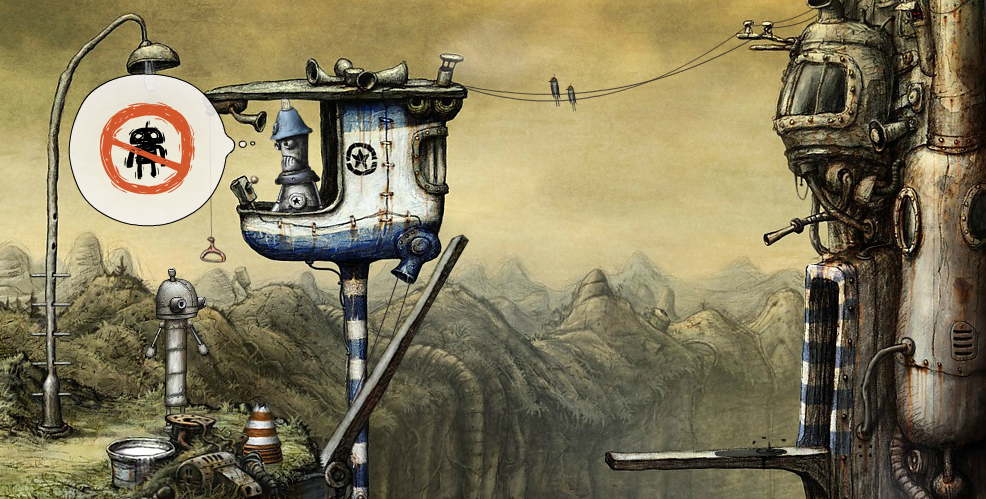
For the last set of opening activities, I had to play the online demo of the award-winning indie game Machinarium while listening to one of the greatest hip-hop albums of all time: Straight Outta Compton by N.W.A. While N.W.A.'s tracks were fantastic by themselves, they did not entirely work in the world of the game. The 80's style beats along with the gangster rhetoric clashed with the industrial environment that Machinarium attempts to immerse you in. I will admit, though, that when Fuck the Police started playing, Josef (the player character) was being denied entrance to Machinarium's eponymous city by the police, and tried to sneak himself in. This disdain for authority really shined through both the music and the player character's actions. This was a neat and unexpected treat for me. The song's theme of resistance also reflects the main plot of the game, which is resistance to a bona-fide police state brought about by a criminal organization. Other than Fuck the Police, I did not find the rest of the music to fit the game's dreary, mechanical mythos. This is very similar to the way many of my friends play their video games: over their own soundtracks. One reason why video games (and movies, by extension) have the capability to be so immersive is because of their sound design. The music and sound effects are meticulously crafted and fit into their game worlds like pieces of a puzzle. Playing Straight Outta Compton while playing Machinarium is like completing a puzzle with a slice of pie. While the pie itself is delicious, and the puzzle appealing, you do not want to put both of them in your mouth at the same time. This is why I decided to stop listening to N.W.A and turn up Machinarium's volume in my second playthrough of the demo. Instead of late-20th century gangster rap, I heard an ambient, mechanized soundtrack, with a dash of chiptune for good measure. The game's music sounded desolate, in a way that could only work in this game. The oily water, the yellow sky, and the squeaks of the protagonist's limbs all seemed to fit into the grand puzzle of the game's sound design, alongside the ambient music.

Machinarium is not the only video game that excels in sound design. The Left 4 Dead series employs an intelligent engine called the Director that not only controls the amount of zombies attacking the players at once, but finely tunes the music and sound to the experience of each player. Small musical motifs play before each of the "special infected" enemies spawn, which serves a dual purpose: to immerse the player by adding tenseness, and alert more cognizant players of what's to come. The Director may also add special musical tracks depending on certain events in the game, such as fighting hordes of zombies, or being attacked by a special infected (Side note: Although L4D isn't a particularly scary game, being unexpectedly jumped by a Hunter while hearing shrill strings shrieking in your ears is enough for me to rocket out of my seat). As discussed by NPR in their podcast Tech Team: Inside Video Games and Gaming, NBA 2K14 is another excellent example of sound design in video games. After months of playing the PC version with my roommate, I was never impressed by the graphics, yet, I was blown away by the sound effects. If you closed your eyes, you'd believe you were in the middle of an actual, real-life NBA game. Every game you play in 2K14 feels radically different from each other, thanks to the thousands of lines of dialogue recorded by actual NBA commentators. They seem to have something new to say each time I play the game, and when it's connected to the Internet, the game pulls actual statistics in the current NBA season and references them in game. For example, I was once playing as the Denver Nuggets and was surprised to hear from one of the commentators that Nate Robinson was on a hot streak in his last few games. Then, you look him up online and find that, yes, #10 is hot in the paint! Muting all of that over your own music seems like an insult to all of the sound designers of the game. NBA 2K14 immersed me in the game like no other game has, and I would never have expected to say that about a basketball game!
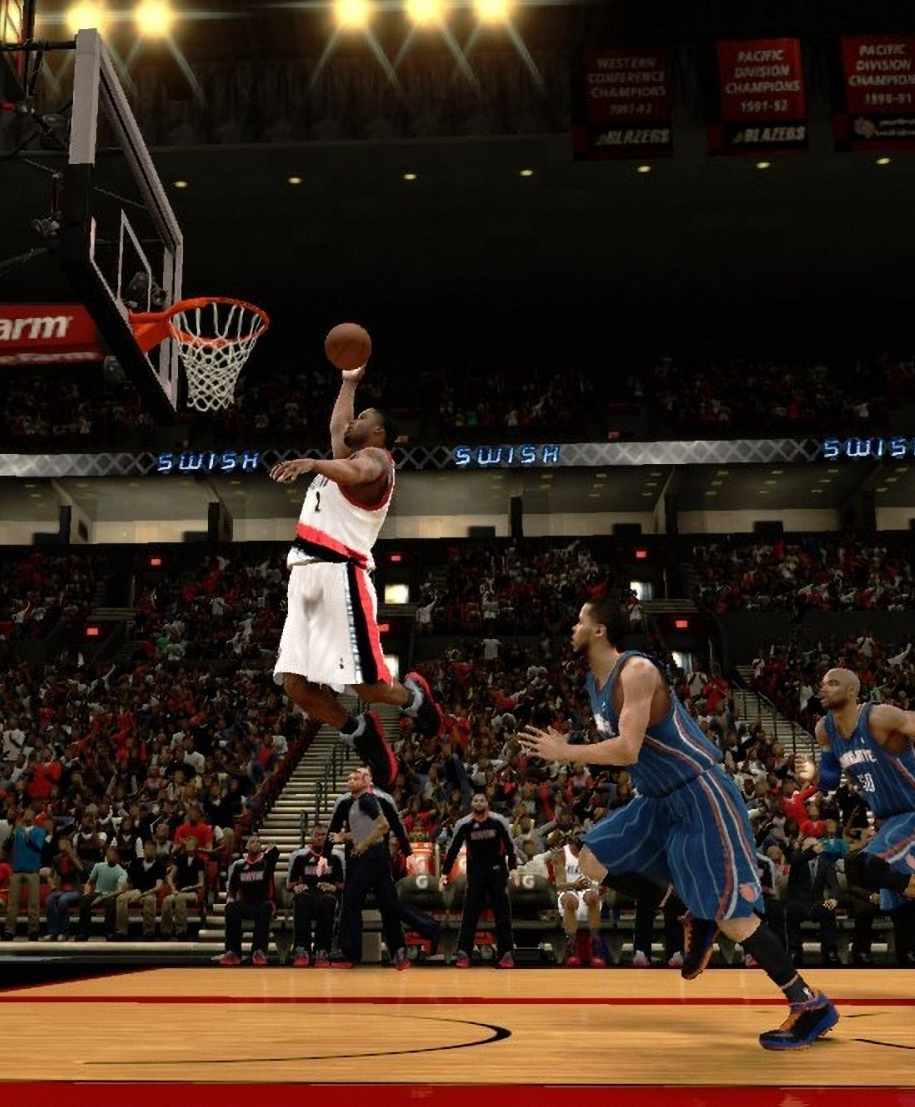
NBA 2K14 has some of the best sound design I've
ever heard in a video game. This can be credited to
the developer's mind-boggling attention to detail
in recreating every sound in a real-life basketball
game.
As Walter Murch demonstrates in his interview about Hollywood sound design, there are many facets of sound that can be implemented in a particular scene. In his example of Apocalypse Now, he showed the dialog track, the helicopter track, and the musical track. In total, there were six layers of tracks that he had to mix together for just one scene. This is similar to what the sound designers of NBA 2K14 had to do, but they had it a little rougher. While Murch had to perfect the sound of one particular scene, the designers at 2K Sports had to visualize many different situations, and build an algorithm that blends the multifaceted sound design of the game in a custom fashion that personalizes it to the in-game action. In a game of NBA 2K14, you hear all of the sounds you'd expect to hear at any basketball game. You hear the roaring of the crowd. You hear the squeaking of the player's sneakers, and you hear the basket flare as a ball sinks through it. You hear the jeers of the players as they foul, and you even hear the silence as the star player attempts that game-winning shot. It's fascinating that we have the technology to not only look realistic, but make them sound realistic as well. It's even more fascinating that we have the technology to virtualize not only a picturesque basketball game, but one that sounds true to the game, from the court to the crowd. You don't have to be a basketball fan to appreciate that.

Sunday, March 30, 2014

Coverage: Star Wars Episode V: The Empire Strikes Back

"Luke, don't jump-- there are spoilers down there!" -Darth Vader

SCRIPT COVERAGE

TITLE:  Star Wars Episode V: The Empire Strikes Back
SETTING: A galaxy far, far away
AUTHOR:  George Lucas
PERIOD: A long, long time ago
PRODUCER:  Gary Kurtz
ELEMENTS ATTACHED: 
SUBMITTED BY: 
SUBMITTED TO: 
READ BY: Darin Simokov
GENRE: Science Fiction
COVERAGE DATE: 03/30/14
SUBMISSION DATE: 


EXCELLENT

VERY GOOD

GOOD

SO-SO

NOT GOOD

PLOT


CHARACTERS
 X


DIALOGUE
 X


STRUCTURE


COMMERCIAL APPEAL


RECOMMEND:X
CONSIDER: 
PASS: 

LOG LINE: Luke Skywalker continues his struggle to subdue and eliminate the Galactic Empire, but not without some help from his friends.

SUMMARY: Set three years after its predecessor, Luke receives a vision of his fallen mentor Obi Wan telling him to train under Jedi Grand Master Yoda in the planet Dagobah. Before he can do that, the Imperial fleet attacks the Jedi base in Hoth. After defeating the fleet, being captured, and escaping, Luke travels to planet Dagobah, where Yoda accepts him as his mentor. After training for a while, Luke becomes haunted by premonitions of Leia and Han Solo in danger. So, he cuts his training off early to save them in Cloud City. Unfortunately, Darth Vader arrives before him. Before he freezes Han in a block of carbonite, Han and Leia profess their love for each other. Vader intends to do the same to Luke. Instead, once Luke arrives, they duel with their lightsabers. After some struggle, Vader severs Luke’s right hand. Conveniently for Vader, this hand also contained his lightsaber. Now defenseless, Luke can only look in horror as Vader reveals the truth about his father. Before Luke can accept Vader’s offer to rule the galaxy with him, he falls down an airshaft, escaping what may have been certain death. After being rescued by Leia, they leave to rescue the frozen Han Solo.

COMMENTS: The original Star Wars set a very high bar for science-fiction movies, but The Empire Strikes Back sets it even higher. It contains all of the memorable characters from A New Hope, in new and exciting conflicts (even Obi-Wan makes an appearance, despite his death in the last movie—thank goodness for Force ghosts!). Although this movie build upon many concepts and plots from A New Hope, it stands well enough on it’s own. Each recurring character is re-established, but has added motivation and new goals. Conveniently,the iconic title crawl at the beginning of the movie orients viewers on what happened and what’s to come. The plot is set far enough from the last so that new viewers don’t have to watch the last episode to understand the fifth. Those who have watched the fourth episode are treated to further character development, and more high-stakes situations, captivating plots and masterful cinematography. The special effects may not have aged well (just ask George Lucas after ruining remaking all of them), but still contribute to the sense of immersion you feel—the sense that you’ve been thrusted upon an enthralling science-fiction world, with a believable and interesting cast of characters.
Anyone who watches this movie is also treated to the best plot twist in cinema history. Nowadays, it’s a shame that the twist is so ingrained in our culture, since it ruins the surprise for new first-time watchers. For them, it’s likely that they learn of the twist shortly after they hear of Star Wars for the first time. For those who don’t know, you need to watch Empire immediately. You’d be foolish to not recommend this.

Saturday, March 29, 2014

Linear Analysis: Birdemic: Shock and Terror

Our protagonists engage the rabid birds for the first time... with coat hangers.
Like The Room before it, Birdemic: Shock and Terror is one of the worst movies of all time. What separates the two movies apart is that it's painfully obvious that the latter has a more restricted budget. Of course, you don't need millions of dollars to reinforce your movie's ideas. Many directors and cinematographers subtily utilize visual motifs in order to bring these points across. Birdemic may be an awful movie, but there has to be something hidden in it, something that would emblazon a mark of competence on the poor souls that produced this film. Today, I'm going to analyze one 30-minute segment of the film to find out.

Note: This report does contain spoilers, in case you actually care. Spoiler alert: This movie's plot isn't exactly what I'd call "riveting."

Tuesday, March 25, 2014

These Songs Rock!

For this assignment, I had to analyze five of the best songs of all time. After reviewing three bad songs and a hilariously awful movie, this was a nice change of pace. Let's begin.


TIGHTEN UP by ARCHIE BELL & THE DRELLS

Listening Phase 1 (Rhythm)

Source [where is the rhythm coming from?] A drumset, a bass guitar, and an electric guitar.

Time/Tempo [guess at the time signature] Most likely 6/8, but could also be 4/4.

Groove [describe how the personality of the rhythm] Makes you want to throw your hands up in the air at least every other measure. The treble notes are low during one measure, then go high the next, giving a roller-coaster feel to the melody.

Listening Phase 2 (Arrangement)

Instrumentation [which instruments drive the song?] A drumset, a bass guitar, and an electric guitar. Also, the occasional trumpet.

Structure/Organization [how is the song built?  Order, patterns, etc.] An introduction, a chorus, a bridge, wrapping up with another chorus.

Emotional Architecture [Draw how the song build and drop?] Builds slowly during the introduction into the chorus, falls slightly during the bridge, then stays full steam ahead until the song fades out.

Listening Phase 3 (Sound Quality)

Balance

-       Height [high and low of frequency] Moderately high and low frequencies, but not much in between.

-       Width [stereo panning left/right] Different instruments dominate each ear, giving a sense of space.

-       Depth [layers of instruments] Four for the most of the song (Bass, precussion, treble, vocals), with a fifth layer added later in the song (brass)

Friday, March 21, 2014

Breaking Bad Color Theory: Skylar Versus Marie


Breaking Bad is a quintessential, contemporary example of symbolism in media. This is especially apparent in its use of color, and the color of the characters' outfits throughout the seasons. For this assignment, I chose to analyze Marie and Skylar's outfits throughout the final season. Through use of color, I discovered details of each of the sisters' personalities, and their feelings throughout the tumultuous events of the last season of one of the greatest television dramas of all time. Check it out through the following link:

http://www.timetoast.com/timelines/832252

Thursday, February 13, 2014

These Songs Suck!

For an assignment, I had to analyze some songs, only these songs are universally accepted as a few of the worst songs of all time. Why do they suck? Let's drill down and find out...

(Also, if you're so inclined, you can click the links to each song title to listen to it. Proceed with caution.)

The Cheeky Song (Touch My Bum) by Cheeky Girls


Listening Phase 1 (Rhythm)

Source: A couple of synthesizers, as well as a computer-generated clapping sound. The vocals consist of two, slightly auto-tuned altos.

Time/Tempo Common time (4/4), 130 beats per minute

Groove The background music lacks personality. The only interesting thing about it is the bass driving it. People will dance to it… if they’re drunk.

Listening Phase 2 (Arrangement)

Instrumentation Mainly synthesizers, with the occasional drums.

Structure/Organization Starts with an introduction, then the first verse, then the chorus. Following the first chorus is a bridge, then a repeat of the first verse, then another bridge, and the last chorus.

Emotional Architecture The song’s architecture was stagnant. It kept the same beat, with no changes until the last bridge.

Listening Phase 3 (Sound Quality)

Balance

-       Height Typically low, especially considering that the two lead singers are probably altos (lower female vocal part.) Bass is apparent but isn’t very low. I definitely didn’t need my headphones to play the beat. The high-frequency parts were the treble synth and the bass synth. A narrow height, but par for the course for most pop songs.

-       Width The only time audio panning is used is during the cymbal hits preceding the chorus. Other than that, the song has the same width.

-       Depth There is four layers: The vocals, the treble synth, the bass synth, and the percussion.

Tuesday, February 11, 2014

Coverage: The Room

The movie's tagline asks: "Can you really trust anyone?" The only question you'll be asking yourself is "Should I have trusted the person who told me to watch this movie?"
Persistent Entertainment
SCRIPT COVERAGE

TITLE:  The Room
SETTING: San Francisco
AUTHOR:  Tommy Wiseau
PERIOD:  Present Day
PRODUCER:  Tommy Wiseau
ELEMENTS ATTACHED:
SUBMITTED BY:
SUBMITTED TO:
READ BY:  Darin Simokov
GENRE:  Drama
COVERAGE DATE: 
SUBMISSION DATE: 


EXCELLENT

VERY GOOD

GOOD

SO-SO

NOT GOOD

PLOT


X

CHARACTERS


X

DIALOGUE


X

STRUCTURE


X
COMMERCIAL APPEAL


X


RECOMMEND:
CONSIDER:  X
PASS: 

LOG LINE:  A San Francisco banker lives happily with his fiancĂ©e, who, unbeknownst to him, is cheating on him with his best friend.

SUMMARY: Johnny got engaged with Lisa an indeterminate time since the start of the movie’s plot. They’ve been living happily, with the occasional unexplained appearance of Denny, whom Johnny is his father figure (he’s even paying for Denny’s apartment and education). After suddenly deciding she no longer loves Johnny, Lisa seduces his best friend, Mark. Mark is initially shocked at the idea, but quickly falls victim to Lisa’s seductiveness. The newly-made lovers attempt to hide their infidelity from Johnny, while trying to keep their friendships together.


COMMENTS:  This movie is almost as confusing as the origins of its director, let’s not even get to where the money spent on this movie came from. After experiencing The Room, I feel convinced that the writer (who is also the director, producer, and the actor of the main character) is actually an alien who has an unrealistically loose grasp of human behavior.
